SACRAMENTO, Calif., October 2026 — ADU Builders California has expanded its engineered foundation and hillside construction services for accessory dwelling units, addressing the large share of California parcels where slope, soil, and seismic conditions put a standard slab on grade out of reach. The company reports that sloped and problem soil sites account for a growing portion of its statewide inquiries — particularly from the Sierra foothills, the Bay Area hills, and Southern California’s canyon neighborhoods — and that most of those homeowners arrive having been told, incorrectly, that their lot cannot support an ADU at all.
The truth, the company says, is more useful: nearly any California lot can host an ADU with the right foundation system, and the real question is cost and design fit. Slopes change the foundation from a commodity line item into an engineered system — stepped footings, stem walls, drilled piers with grade beams, or pole framing — and they bring geotechnical investigation, drainage engineering, and seismic detailing to the front of the project. Handled early, these are manageable costs with known ranges. Discovered late, they are the classic source of ADU budget blowouts.
“The most expensive sentence in hillside construction is: we’ll figure out the foundation later,” said a spokesperson for ADU Builders California. “A soils report costs a few thousand dollars and tells you what the ground will demand before you commit to a design. We have seen homeowners spend their entire contingency repairing a plan that was drawn for flat land and priced for a slab. Our process puts the geotechnical answer first, and everything downstream gets cheaper because of it.”
Foundation Systems by Slope and Soil
The company’s expanded service matches systems to conditions across four broad tiers. Gentle slopes up to roughly 10 percent typically take stepped footings or a stem wall foundation with a modest crawl space, adding 8,000 to 20,000 dollars over a flat lot slab. Moderate slopes of 10 to 25 percent usually call for stem walls with significant retained height or drilled concrete piers tied by grade beams, with foundation packages commonly running 30,000 to 60,000 dollars and the reward of leaving the natural grade largely undisturbed. Steeper sites move to full pier and grade beam systems or pole construction, where the structure stands on engineered columns above the slope; foundation costs of 60,000 to 120,000 dollars are realistic, but these systems unlock dramatic sites — and views — that owners often considered unbuildable. The fourth tier is flat land with bad ground: expansive clays that swell and shrink seasonally, uncompacted fill, and high water table soils, each resolved by deepened footings, post tensioned slabs, or piers reaching competent material.
Every tier begins with the geotechnical report. A residential scope investigation — borings or test pits, laboratory analysis, and foundation recommendations — runs 2,500 to 6,000 dollars for a typical ADU site and is, in the company’s framing, the highest leverage document in hillside construction. The report sets the foundation design, the drainage requirements, and in hillside zones the slope stability analysis that many jurisdictions require before they will accept an application at all.
Seismic Detailing Beyond the Foundation
California’s seismic code shapes the structure above the foundation as well, and ADUs on slopes carry particular requirements. Split level and stepped designs create torsional irregularities that demand careful shear wall distribution; tall crawl spaces and pony walls — a known collapse vulnerability in older hillside homes — are engineered with braced cripple walls and continuous load paths in new construction; and pier supported structures receive moment connections and lateral bracing sized to the site’s mapped seismic parameters. The company builds these details into its standard hillside structural packages and coordinates stamped engineering on every sloped site project.
Drainage is the quiet half of hillside performance. Water moving down a slope must be collected above the structure and conveyed around it — through surface swales, subdrains behind retaining elements, and foundation drainage mats — or it will find the building. The company treats hillside drainage as a designed system with its own plan sheet, noting that the majority of hillside foundation problems it is called to repair on existing structures trace to water management rather than to the original structural design. Erosion control during construction, mandatory on sloped sites under state stormwater rules, is sequenced into the schedule from day one, and on fire prone slopes the design folds in the defensible space and ember resistant detailing that hillside jurisdictions increasingly require.
Budgets, Honestly Stated
Summing the components, the company publishes candid planning ranges: a hillside ADU typically costs 15 to 35 percent more than the same floor plan on flat ground, with the premium concentrated in foundation, retaining, drainage, and the added engineering and investigation fees. On a 750 square foot detached unit that might price at 300,000 dollars on a flat Sacramento lot, the equivalent moderate slope project plans realistically at 350,000 to 400,000. Against that premium stand real offsets. Hillside lots are frequently the least utilized land a homeowner owns — yard that has never served a purpose because it slopes. Units on elevated sites command view premiums in both rent and resale that flat lot units cannot match; the company’s view oriented hillside units have rented at 10 to 20 percent above comparable flat site units in the same submarkets. And on parcels where the main house occupies the only flat pad, the slope is simply where the opportunity is: the choice is a hillside ADU or no ADU.
“Nobody should sugarcoat hillside costs, and we do not,” the spokesperson said. “What we push back on is the reflex that slope means impossible. California’s hills are full of underused land attached to houses that need housing next to them. The engineering to use that land is mature, the code supports it, and the state’s ADU laws apply on a slope exactly as they do on a flat lot — ministerial approval, objective standards, sixty day clock.”
Process: Investigation Before Commitment
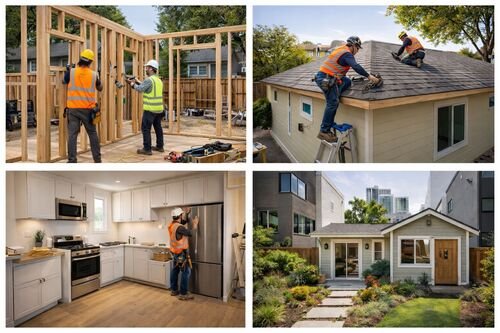
The expanded service is structured to let homeowners spend small before spending large. Step one is a site walk and records review — slope mapping, utility locations, any hillside overlay or geologic hazard zone designations affecting the parcel. Step two commissions the geotechnical report. Step three delivers a foundation concept with a priced range and a go or no go recommendation; homeowners who stop there have spent a few thousand dollars for certainty instead of six figures for a surprise. Projects that proceed move into the company’s standard design build sequence, with the structural and civil engineering coordinated in house and the construction schedule built around the dry season rules that govern all sloped work: grading and foundation in the dry months, weather protected phases through the winter.
Homeowners with sloped or questionable soil parcels can begin with the feasibility assessment described at adubuilderscalifornia.com, which the company has extended this fall to include the hillside screening steps at no added cost for sites in its statewide service area.
Timing for the 2027 Season
Hillside schedules are the most season bound in the company’s portfolio, because grading on slopes is effectively frozen once sustained rains saturate the ground — and in many hillside jurisdictions, formally restricted during the wet season months. The practical calendar for a 2027 hillside completion therefore starts now: geotechnical work and design through late fall, permits over the winter, groundbreaking in late spring as soils dry, and the weather sensitive earthwork completed in the heart of the dry season. Homeowners who begin investigation in October hold every scheduling option; those who wait until spring to start the soils report typically lose the grading season to permitting and slip a full year.
The company reports that its hillside and engineered foundation projects now span from foothill towns east of Sacramento to coastal canyon lots in Southern California, and that the category’s growth reflects a simple statewide fact: the flat, easy lots are increasingly built out, and the next generation of California ADUs will be constructed on the ground that remains.
Retaining Walls, Access, and the Supporting Cast
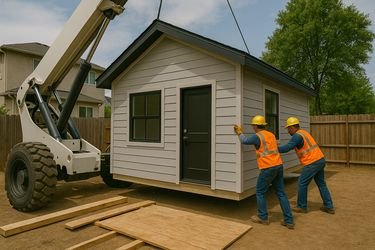
Two supporting scopes deserve their own budget lines on sloped sites. Retaining structures — needed to create level entries, patios, and pathways around the unit — are permitted and engineered separately once they exceed modest heights, and the company prices them honestly in feasibility reports: a typical hillside ADU project carries 10,000 to 40,000 dollars of retaining and site stair work depending on grade change and finish. Construction access is the second: steep sites without equipment access require material handling by smaller machines, conveyors, or in extreme cases crane service, and labor hours rise with every vertical foot materials must travel. The company’s estimators walk every slope before bidding, because two lots with identical plans and identical soil can differ by 30,000 dollars on access alone.
Utilities complete the picture. Sewer service on downslope lots sometimes requires a private ejector pump where gravity flow cannot reach the lateral, a 6,000 to 15,000 dollar system with ongoing maintenance that the company discloses up front rather than discovering at rough in. Water pressure on upslope sites, trench routing through rock, and electrical runs across long sloped yards are each checked during the initial site walk. None of these items is exotic; all of them are simply hillside facts that belong in the first conversation and the first budget, which is where the company’s expanded service puts them.
About ADU Builders California
ADU Builders California
1610 R St Suite 300
Sacramento, CA 95811, United States
Phone: (916) 277-8760
https://adubuilderscalifornia.com